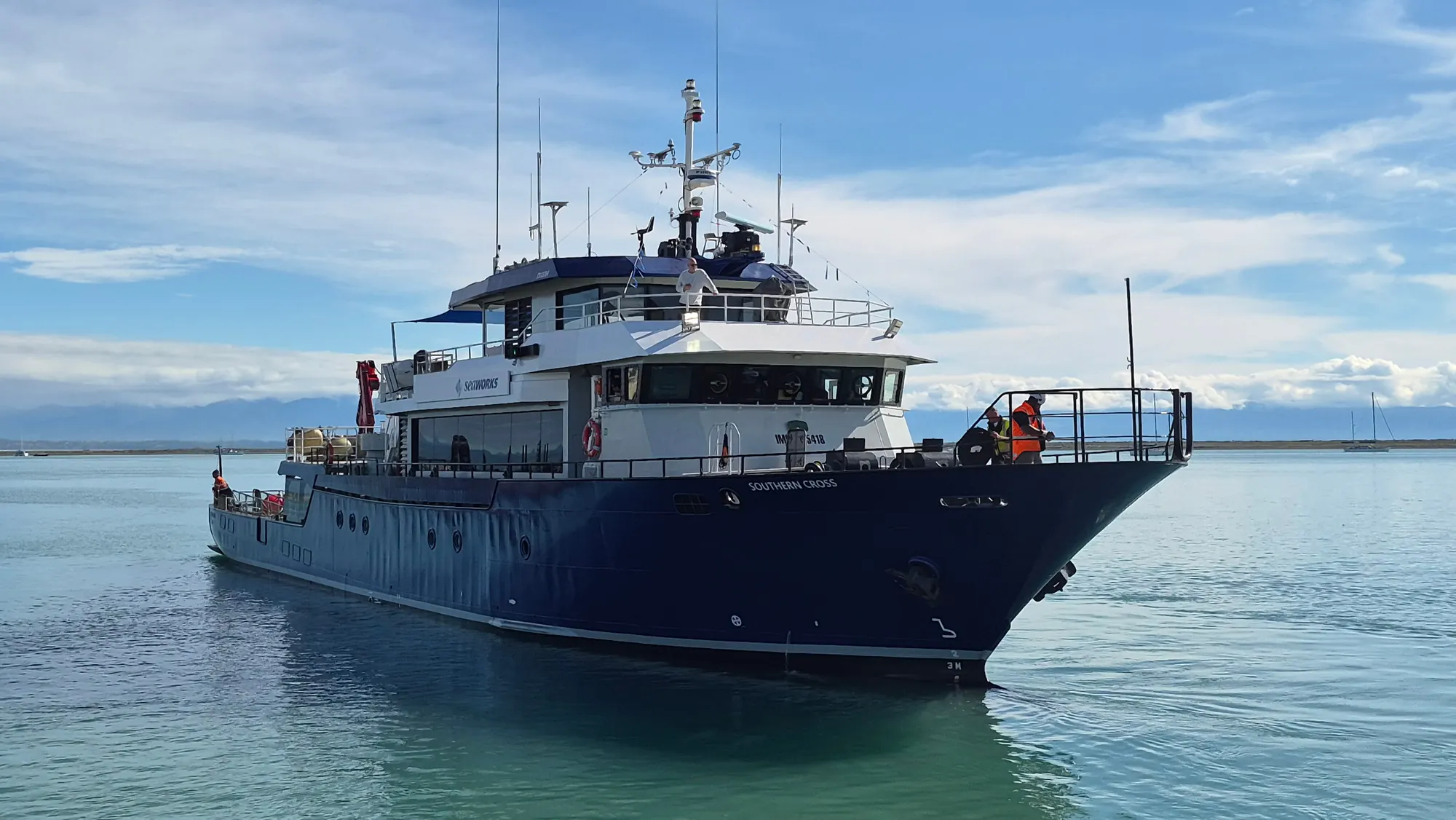
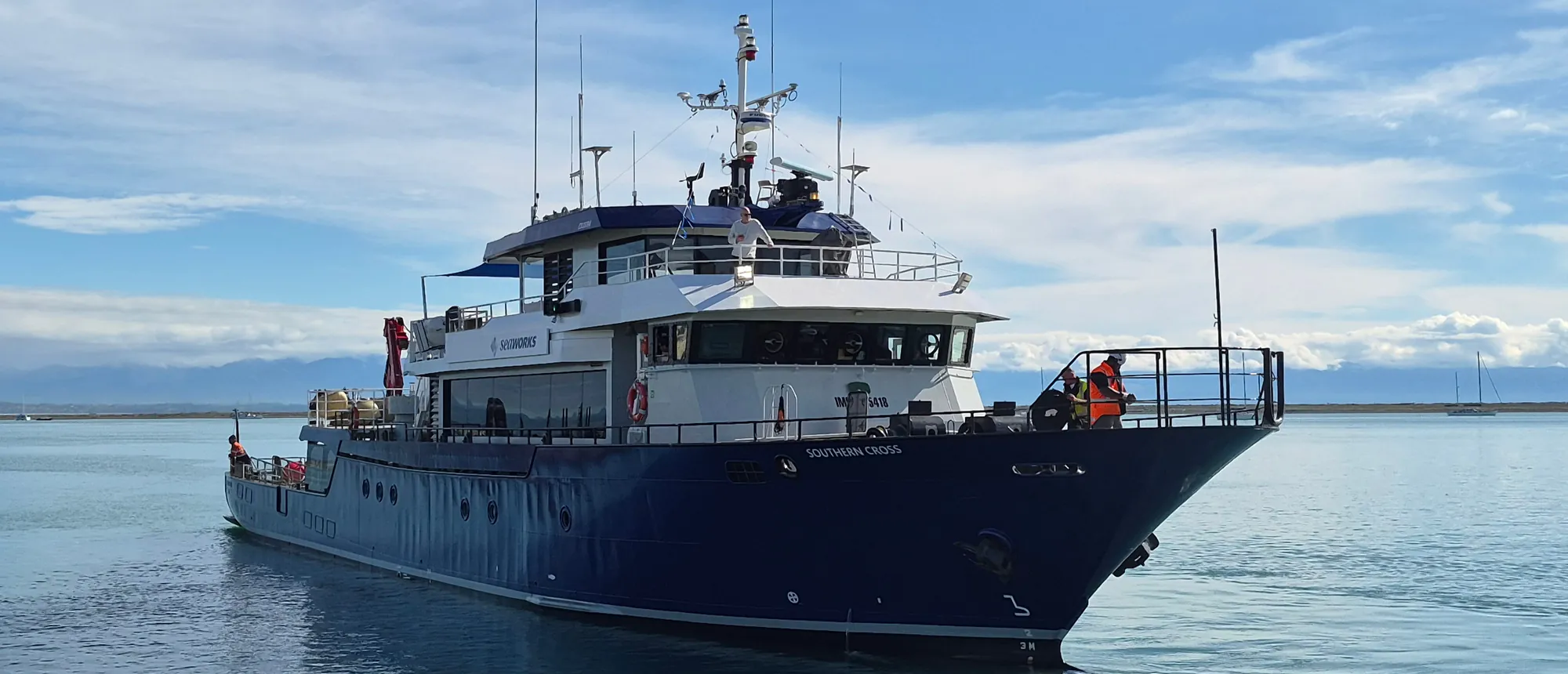
R/V Southern Cross at anchor in calm water

Seabed mineral offshore services

Seaworks research vessels and Phoenix International subsea systems, working as one team on seabed mineral exploration, data collection and offshore development in deep water.

Integrated capabilities, proven expertise

Seaworks brings the vessels, crews and offshore experience. Phoenix International brings the ROVs, AUVs, deep ocean handling systems and engineering. Together they support exploration, data collection and future offshore development in complex deepwater environments.

Seaworks

Established in 1981, Seaworks is a leading marine services provider across New Zealand and the South Pacific, with diverse vessel capabilities, proven offshore experience, a strong safety record and triple-ISO-certified quality, safety and environmental standards.

  • Research and survey vessels, crewed and operated
  • ISO 9001, 14001 and 45001 assured
  • New Zealand and South Pacific operations
seaworks.co.nz

Phoenix International

Phoenix International delivers specialised underwater services and engineering for complex marine operations worldwide. Its fleet of ROVs, AUVs and supporting systems brings advanced subsea technology to deepwater exploration and data collection.

  • ROV and AUV rated to 6,000 m
  • Deep ocean winch and cable systems to 10,000 m
  • In-house electrical, mechanical, ocean and naval engineering
phnx-international.com

The vessels

Two Seaworks research vessels: one set up for deep ocean mapping, the other for sampling, AUV support and general survey.

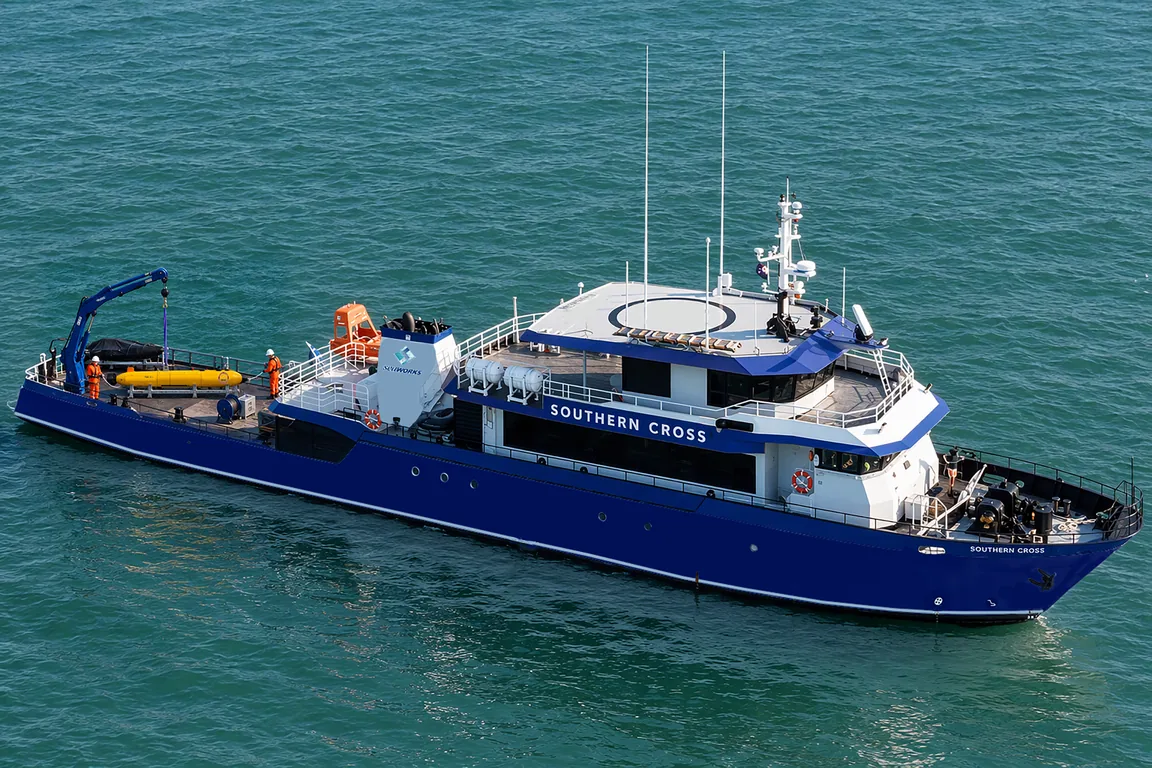
R/V Southern Cross from the air, with survey equipment on the aft deck

R/V Southern Cross

Deep ocean hydrographic research vessel

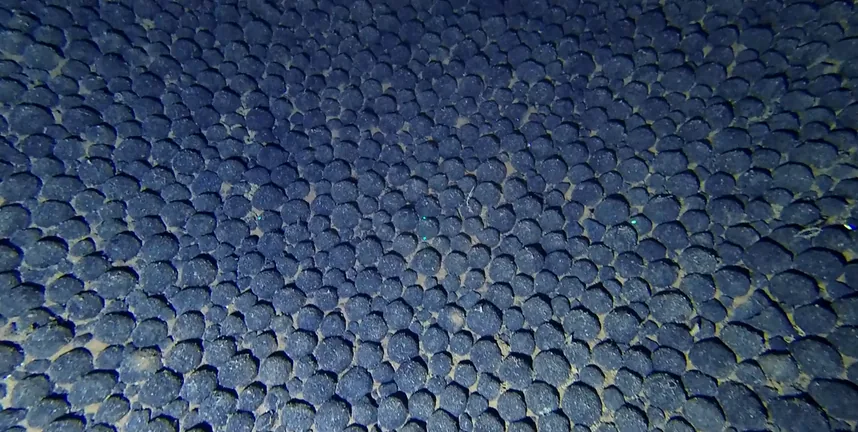
A former Japanese hydrographic research vessel, fitted with the Kongsberg EM 124 multibeam and configured for deep ocean polymetallic nodule exploration, benthic habitat studies and bathymetric data collection.

Length overall
44.6 m
Gross tonnage
319 t
Service speed
9 kn
Berths
18
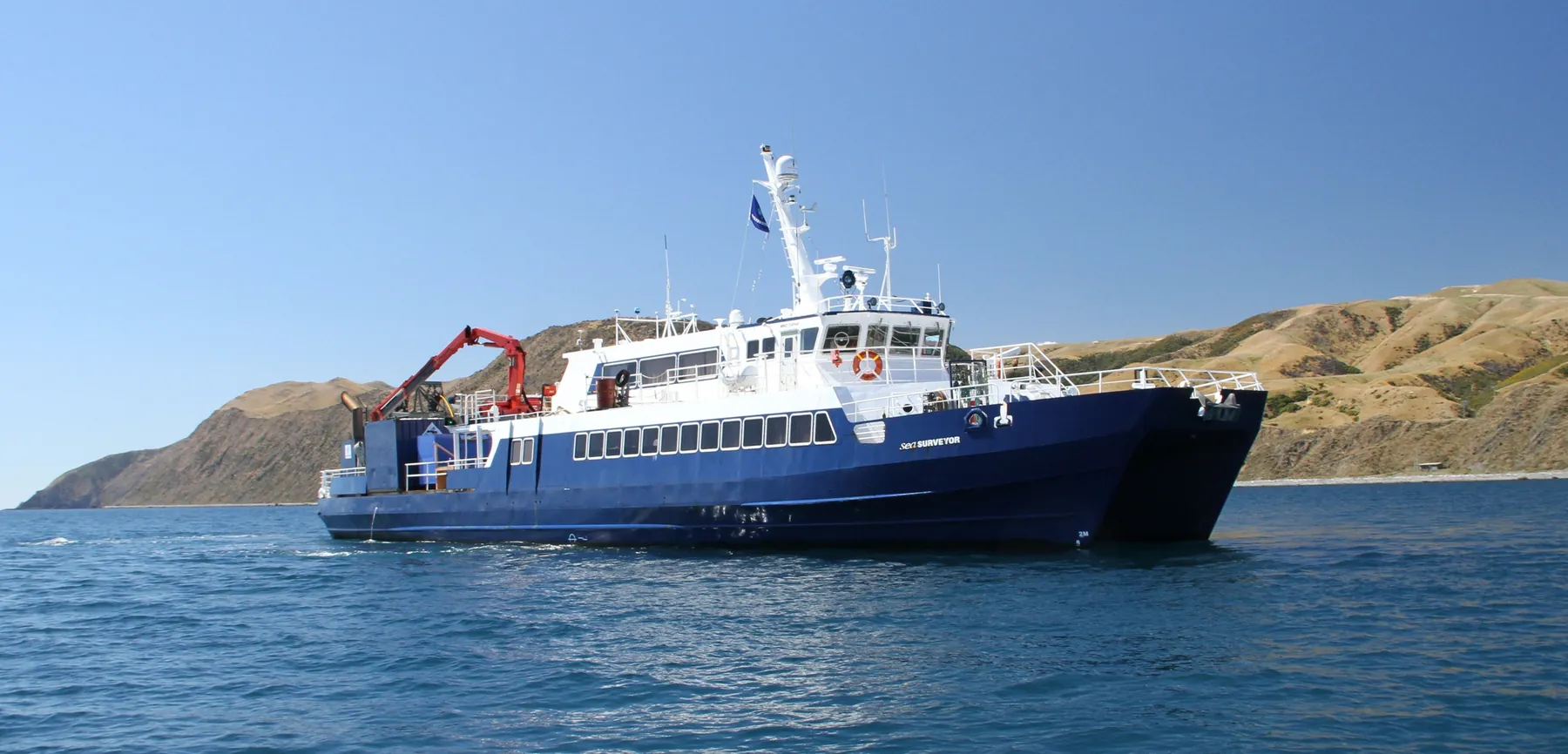
R/V Seasurveyor, a blue and white catamaran, at anchor off a dry hillside

R/V Seasurveyor

AUV support, dive support, seabed sampling and general purpose catamaran

A 39 m multipurpose research catamaran, refitted in 2022. A 4 t winch and A-frame handle a wide equipment list, from MBES and USBL to box coring, multi coring and baited cameras.

Length overall
39 m
Gross tonnage
359 t
Service speed
9.5 kn
Berths
22

Sunlight zone

Where the survey vessel works. Sunlight reaches down to about 200 m.

Subsea systems

Phoenix International's vehicles and handling systems put sensors, cameras and manipulators on the seabed, launched and recovered from the Seaworks vessels.

How deep each system reaches Seaworks vessel equipmentPhoenix International

Vehicle figures are depth ratings. Winch figures are cable or line length.

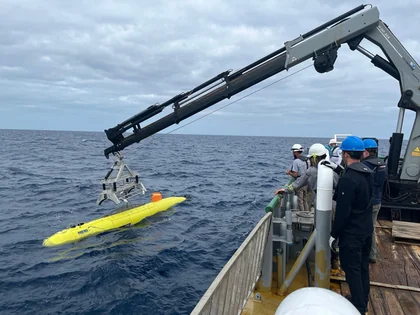
Yellow SeaRaptor AUV being lowered from a ship's crane into the sea

SeaRaptor AUV

Rated to 6,000 m (20,000 ft)

  • Kraken synthetic aperture sonar (miniSAS)
  • Multibeam and sub-bottom profiler
  • Magnetometer and environmental sensor
  • UHD camera and laser sensor
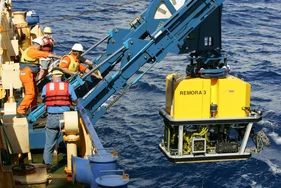
Yellow Remora ROV suspended over the side of a vessel by a crane

Remora ROV

Rated to 6,000 m (20,000 ft)

  • 40 hp electro-hydraulic, designed and built in-house
  • 2 × Schilling Orion manipulators
  • 3 cameras: imaging, low light and multi-sea
  • Simrad 470 scanning sonar
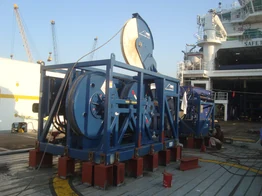
Large blue deep ocean winch drum on a ship's deck

Deep ocean winch and cable systems

Cable to 10,000 m

  • Traction winch and cable, 10,000 m
  • High-speed winch and cable, 5,000 m
  • Heave compensator
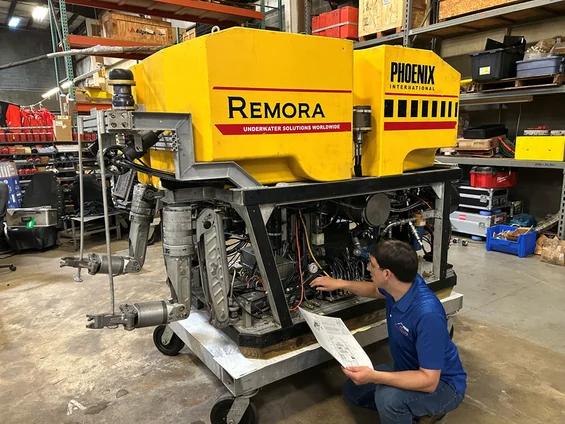
An engineer working beside the Remora ROV in a workshop

Engineering

Designed and supported in-house

Phoenix's multidisciplinary team includes electrical, mechanical, ocean and marine engineers and naval architects.

Mapping to full ocean depth

The Kongsberg EM 124 on R/V Southern Cross is a 1° × 2° deepwater multibeam echosounder that maps to 11,000 m. Its bathymetry and backscatter guide where the AUV, ROV and samplers go next.

Depth under the ship

4,893 m

×2
5,000 m

Drag to change the depth under the ship.

Swath width
14.0 km
Footprint along track (1°)
87.3 m
Footprint across track (2°)
174.5 m
Two-way travel time
6.7 s

Seabed: bathymetry and backscatter from the R/V Southern Cross EM 124 (50 m grid, shown at 150 m). The ship's run is a time-lapse replay; the line order and swath painting are illustrative. Swath shown at 2.8× water depth (14 km at 5,000 m). Footprint at nadir from the 1° × 2° beamwidth. Travel time assumes 1,500 m/s.

Simulated seabed. Swath shown at 2.8× water depth (14 km at 5,000 m). Footprint at nadir from the 1° × 2° beamwidth. Travel time assumes 1,500 m/s.

  • Full ocean depth mapping, down to 11,000 m
  • Dual swath mode with up to 1,600 soundings per ping cycle
  • Swath coverage up to about 5.5 times water depth
  • Sounding density capable of 10 m grid resolution
  • Bathymetry and backscatter at high resolution
  • Sub-bottom profiling, software-enabled via EM SBP
  • IHO Special Order survey specification
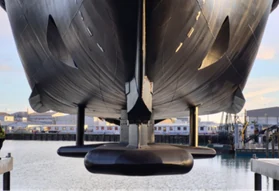
Hull-mounted EM 124 sonar array seen from below the ship in dry dock
Hull-mounted Kongsberg EM 124

Meet us at UMC 2026

Underwater Minerals Conference, Toyama, Japan. 8 to 13 November 2026.

Program and timings below are in Japan time.

Phoenix International is a sponsor of UMC 2026. Bring your survey questions to the team in Toyama.

Sunday 8 NovemberWelcome reception

  1. 15:00

    Pre-registration opens

    Desk located outside the welcome cocktail

  2. 17:00–21:00

    Welcome cocktail

    Toyama Hilton Doubletree Hotel (open bar). Introduction by Dr. Mark Luther: welcome and introduction of IMMS, then a speech by the host (TBD).

Poster sessionTuesday 10 November, 17:00. 49 posters
  1. P1

    Development and Application of Th-228 for Tracking Deep-Sea Sediment

    Abby Malatia, Eckerd College, USA

  2. P2

    Environmental Impacts, Governance Gaps, and Legal Perspectives—A

    Adam Ashby, Bushmead Environmental, UK

  3. P3

    Using AI and Marine Robotics to Build High Resolution Digital Twins of

    Alexander Petersen, MOBY Robotics, USA

  4. P4

    Techno-Economic Model and Validation of a Novel Nodule Collection System

    Anna Scott, Mithril Minerals, USA

  5. P5

    Using Environmental Impact Assessment to strengthen consistency and

    Becky Hitchin, ERM, UK

  6. P6

    Innovative Research Supporting Responsible Deep-Sea Nodule Collection

    Britt Blankenaar, Allseas Engineering B.V., Netherlands

  7. P7

    Quantifying 3D Mn/Fe variation in polymetallic nodules

    Cara James, Univ. of British Columbia, Canada

  8. P8

    Towards the validation of ABC Transporter proteins as potential biomarkers of

    Carmen Sousa, University of Algarve, Portugal

  9. P9

    Developing a Scientifically Robust Environmental Monitoring Program

    Christopher J Kelly, CSA Ocean Sciences Inc., USA

  10. P10

    Integrating Complex Offshore Survey Operations in American Samoa

    Dave Bernstein, NV5, USA

  11. P11

    Managing Complexity Beneath the Surface: Coordinating Multi-Contractor

    Deborah Kilbane, CSA Ocean Sciences Inc., USA

  12. P12

    Why Great Research Gets Forgotten

    Edgar Kutschera, FRANE Media, Germany

  13. P13

    Deep-sea survey for Fe-Mn crust using a hovering-type AUV

    Eiichi Kikawa, IDEA Consultants, Inc., Japan

  14. P14

    Choppy Waters: Navigating Conflicting Regimes

    Elena Guillet, Haynes and Boone CDG LLP, USA

  15. P15

    Polymetallic Nodule Resource Classification and Exploration Approach

    Erik Werner, RSC and Deep Sea Vision, New Zealand

  16. P16

    Design Progress of a Free-Standing SMS Mining Vertical Transport System

    Frank Lim, 2H Offshore, UK

  17. P17

    Quantitative Resource Assessment of Cobalt-rich Ferromanganese Crusts on

    Gyuha Hwang, KIOST, South Korea

  18. P18

    Automated Segmentation of Deep-Sea Polymetallic Manganese Nodules Using

    Hikari Sano, Akita University, Japan

  19. P19

    Practical operation of deep-sea rare-earth mud mining system

    Hiroyuki Yamamoto, JAMSTEC, Japan

  20. P20

    Mapping the Wider Environmental Context of Deep-Sea Mining in the CCZ

    Jack Ingledew-Gale, TMC, Canada

  21. P21

    Autonomous Seafloor Sampling with the Orpheus AUV

    Jake Russell, Orpheus Ocean, USA

  22. P22

    Assessment of Deep-Sea Mining Benthic Plume Footprint, Sedimentation

    Joaquim Bento, The Metals Company, Canada

  23. P23

    Seafloor Massive Sulfide Deposits: Where are the big and rich deposits?

    John Jamieson, University of Ottawa, Canada

  24. P24

    Baseline Comparison of Sedimentary Biogenic Silica in the CCZ and Cook

    Josef Flieg, Eckerd College, USA

  25. P25

    Monte Carlo Framework for Reliability and Economic Assessment

    Kamlesh Joshi, Deep Reach Technology, USA

  26. P26

    Hydrometallurgical Processing of Cobalt-rich Ferromanganese with Hydrogen

    Ken Adachi, Tohoku University, Japan

  27. P27

    Norway's Science-Based Approach to Seabed Minerals

    Kjersti Dahle, Norwegian Offshore Directorate, Norway

  28. P28

    Improving the flotation selectivity of cobalt-rich ferromanganese crusts

    Ko Miyagawa, Hokkaido University, Japan

  29. P29

    Integration of Deep-Sea Resources into Existing Flowsheets

    Kristian Mackowiak, Kingston Process Metallurgy, Canada

  30. P30

    Ecotoxicological effects of deep-sea sediments from Pacific polymetallic

    Leandro Marinho, University of Algarve, Portugal

  31. P31

    Photogrammetry: Advancing the Next Generation of Ecological Baseline

    Loic Van Audenhaege, NOC, UK

  32. P32

    Inferred Ocean Core Complexes from New Bathymetric Interpretation

    Lucio Martins, Geological Survey of Brazil, Brazil

  33. P33

    Application of magnetic surveys as a reconnaissance tool

    Lukasz Smajdor, Polish Geological Institute, Poland

  34. P34

    Rethinking Calls for a Moratorium on Deep-Seabed Mineral Development

    Makoto Seta, Waseda University, Japan

  35. P35

    Origin and Redox Conditions of Fe-Mn Crust Formation at Sirius Mount

    Marcos Nobrega, Geological Survey of Brazil, Brazil

  36. P36

    Nodule Abundance Estimation from Analysis of Seafloor Photographs and

    Mark E Mussett, University of South Florida, USA

  37. P37

    Institutional Design of the Environmental Compensation Fund in the Area

    Norihito Samata, Musashino University, Japan

  38. P38

    Trident Project for Deep-Sea Impact Assessment and Persistent Monitoring

    Pedro Madureira, INESC TEC, Portugal

  39. P39

    Reflections on Social Impact Assessment for an Emerging Industry

    Rachel Houmphan, The Metals Company, Canada

  40. P40

    Radioisotope Landscape Approach for Sediment Chronometers and Tracers

    Rebekka Larson, Eckerd College, USA

  41. P41

    Integrated GIS-based Delineation for Ferromanganese Crusts

    Seungjin Yang, KIOST, South Korea

  42. P42

    Chemical spatial distributions in polymetallic nodule deep-sea mining plumes

    Shelby Gunnells, Texas A&M University, USA

  43. P43

    Deep Ocean Dynamics from CTD Data in the Cook Islands EEZ

    Steven D Meyers, University of South Florida, USA

  44. P44

    An Introduction to the DREAMS Project

    Tae-Kyeong Yeu, KRISO, South Korea

  45. P45

    Reviewing Migratory Species, Threatened Species and Ecologically Sensitive

    Tami Haase, The Metals Company, Canada

  46. P46

    Self-lift: an innovative recovery system for shallow type methane hydrate

    Tetsuo Yamazaki, Osaka Metropolitan University, Japan

  47. P47

    Advancing Deep-Sea Critical Mineral Mapping and Environmental Monitoring

    Tim Battista, NOAA, USA

  48. P48

    Aqueous Metal Leaching and Density Based Sorting of Sulfide Deposits

    Vladislav Slabov, Norwegian University of Science and Technology, Norway

  49. P49

    Technical Specifications for Integrated Database of Deep-Sea Polymetallic

    Xiande Tian, National Marine Data and Information Service, China

Poster titles are shown as printed in the program, where some are shortened.

Based on the UMC 2026 program, revision 11. Times are local (JST) and subject to change.

Talk to the team

For vessel availability, survey scope or subsea support, contact either company. They will bring in the other.